
SERP insights · Sybel Micro Solutions
What Is ERP Software and How Does an Integrated ERP System Work?
ERP software connects business functions through shared records and related workflows. Learn how that connection helps teams interpret orders, stock, purchasing and finance.
What is ERP software?
Enterprise resource planning, usually called ERP, is software for managing related business functions through a connected set of records and workflows. A business may use it for sales, purchasing, stock, production, people and accounting. The useful idea is connection: an operational event can be understood by the next team without reducing the whole business to one spreadsheet.
A record is more useful with context
Consider a customer order. Sales needs the agreed items, quantities and delivery information. Stores needs the dispatch location and available stock. Purchasing may need to arrange supply, while production may need a reviewed BOM and work order. Finance needs the eventual invoice and settlement context. These are different responsibilities, even when they begin with the same customer requirement.
Integration does not mean every step is automatic
An order, delivery, invoice and receipt are distinct events. A business may review or approve each at a different point, and direct entry modes can change the working sequence. Good ERP procedures preserve those meanings. A submitted document is not necessarily posted, and a pending approval is not evidence that stock or money has moved.
Master data gives transactions a common language
Customers, suppliers, items, units, locations and accounts provide the reference information used by transactions. Inconsistent master data creates ambiguity downstream: the wrong location can distort a stock decision, while an incorrect unit can affect quantities. Implementation therefore needs named ownership for maintaining records, not just an initial data import.
How reporting fits
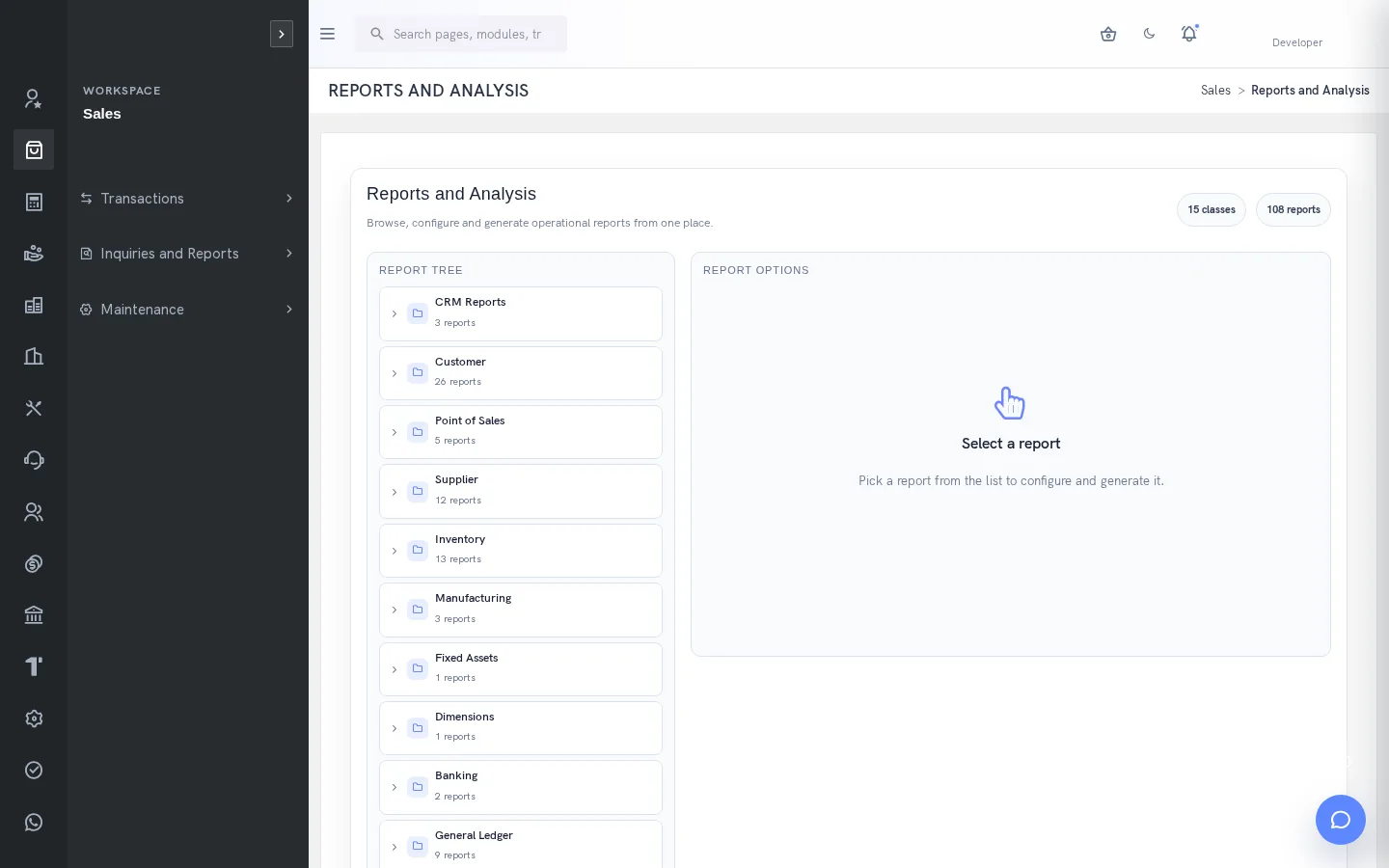
An ERP report should answer a defined question with a clear scope. Dates, company, currency, location and dimensions can change the meaning of a result. When reports disagree, compare these choices before assuming the underlying transactions are wrong. Drilldowns and inquiries help a reviewer explain the source of a balance or movement.
Why permissions matter
Different people enter information, approve exceptions and process financial activity. Permission design needs to reflect those responsibilities. Seeing a record is not equivalent to authority to alter it, and an employee profile should not expose payroll administration. Test roles through real tasks and verify denied actions as well as allowed ones.
What modular ERP means
Modular ERP organizes functions into areas that can be enabled and configured around requirements. This can make the implementation discussion more focused: begin with the workflows that matter now, then confirm additional scope. A module name alone is not enough evidence of suitability. Demonstrate the specific entry, review, reporting and exception handling needed by the organization.
How SERP approaches connected operations
SERP is the ERP/business management platform from Sybel Micro Solutions. Its documented areas include CRM, sales, purchasing, inventory, manufacturing, HR and finance, with cross-functional reporting, documents, approvals and AI assistance. Availability depends on company configuration and user access. Explore the SERP platform and module guides for the actual capabilities.
Prepare for a useful ERP evaluation
Choose one representative process and trace it from requirement to result. Bring the people who perform each handoff, the reports they use and one exception that causes difficulty today. Ask what establishes completion at each stage. This gives the demonstration a concrete objective and helps distinguish a supported workflow from an assumption.
How should a growing business start?
Start with a workflow that crosses departments. Record which customer, supplier, item and account data it uses and who maintains each record. Follow a normal transaction and one exception before deciding which modules belong in the initial scope.
A useful first phase has an agreed result: staff can find the right source record, understand the outstanding requirement and explain the resulting balance. This is more concrete than treating deployment alone as completion.
Does integrated mean every action is automatic?
No. Integration relates records; automation performs a defined action under configured conditions. Approvals, scheduled communication and AI assistance have different responsibilities and effects. In SERP, a customer payment still needs the intended allocation and an AI BOM proposal still needs engineering review.
A few useful answers
Frequently asked questions
What should readers verify in practice?
Start with a workflow that crosses departments. Record which customer, supplier, item and account data it uses and who maintains each record. Follow a normal transaction and one exception before deciding which modules belong in the initial scope.
Does a feature label establish availability?
No. Confirm enabled functions, the intended workflow and the permissions for the target company.
Where should we start learning about ERP concepts?
Read the ERP guide and use the related modules to connect definitions with actual workflows.
See how your business connects with SERP.
Bring your processes, priorities and questions. Let’s make the demonstration useful for your team.
Request a Demo →