
Connected ERP modules
Quality Management ERP, connected to your business
Record incoming, in-process and outgoing inspections, observations, deviations and calibration evidence with SERP quality workflows.
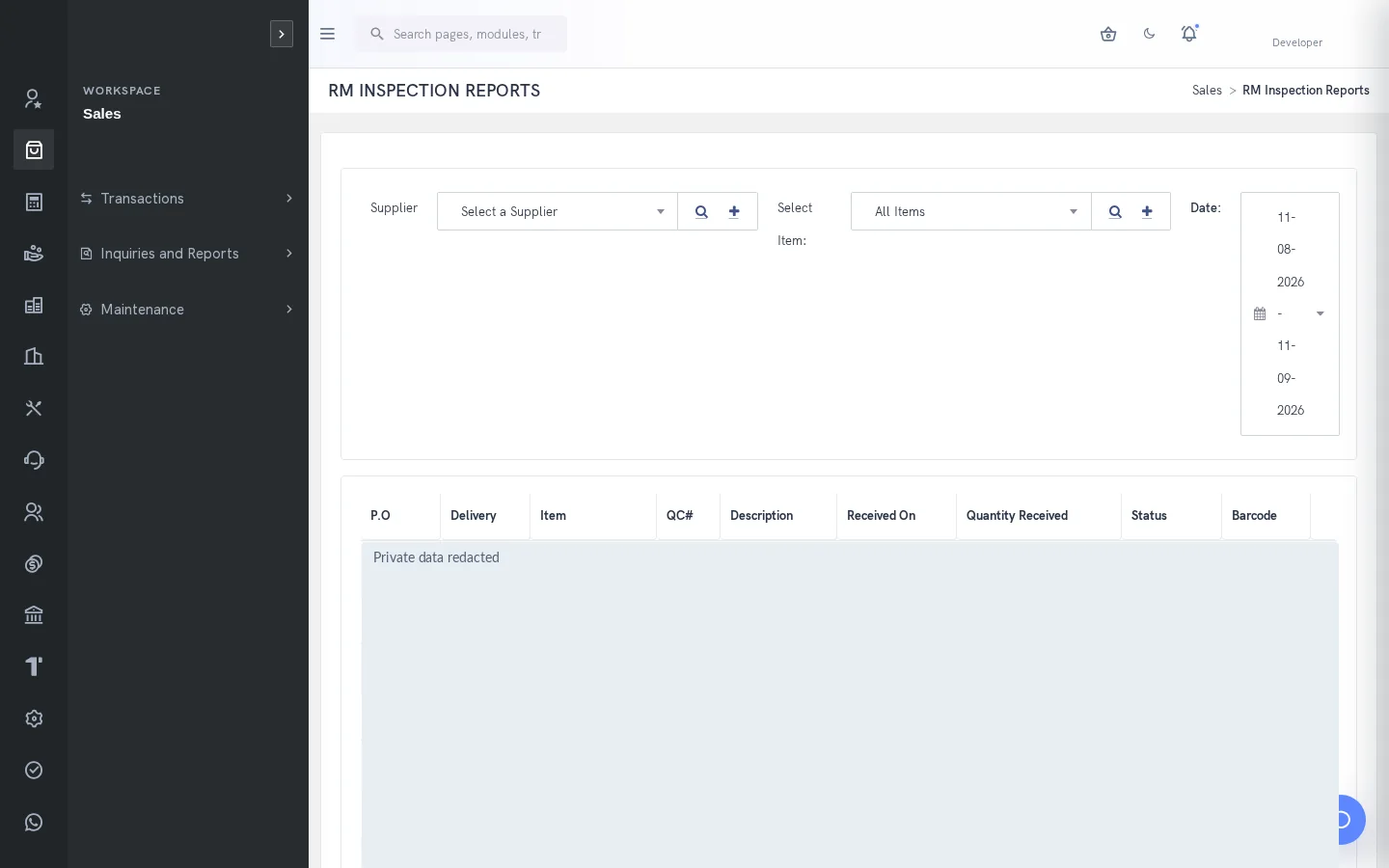
A clearer way to manage quality management
Quality teams need to preserve what was checked, at which stage and against which criteria. SERP separates raw-material, semi-finished, finished-goods and job-work checks, supporting inspection evidence and follow-up without collapsing every quality decision into a single status.
What is quality management in SERP?
SERP is an integrated ERP/business management platform from Sybel Micro Solutions. Its quality management capabilities support the operational records, inquiries and authorized actions described below. Teams can follow a requirement through the relevant business records instead of interpreting isolated status updates. Availability depends on enabled company functions and the user’s role.
Key capabilities
Stage-specific inspections
Choose the relevant material and inspection stage, then identify the receipt or production context. Incoming checks, first-piece checks, in-process activity and outgoing checks address different questions. Retaining that distinction makes reports easier to interpret and avoids comparing measurements from different stages as though they were equivalent.
Plans and parameters
Maintain quality assurance plans, item-specific parameters, inspection methods, severity and acceptance criteria through authorized setup. Lot sizes and AQL settings provide inspection context. The existence of these settings is not a certification claim: the organization remains responsible for selecting appropriate methods and using them consistently.
Observations and closure
Record observations with classification and an assigned person. Use outstanding observations and closure functions to follow the issue through investigation. A closed observation records one outcome; it should not be used as a substitute for a separate authorized deviation decision where that is required.
Deviations and instruments
Use the documented approval-under-deviation workflow for the relevant exception. Maintain testing instruments and calibration evidence so inspection results can be interpreted in context. Calibration inquiry and stage-specific inspection reports help reviewers find supporting evidence rather than relying only on a summary display.
How the workflow connects
Identify contextSelect inspection planRecord resultsAssign observationReview resolution
Putting the workflow into practice
An incoming inspector can relate a raw-material check to its receiving context. A production supervisor can follow observations around finished or semi-finished goods. A quality manager can review instrument and calibration information alongside inspection reports. The useful result is an explainable decision supported by the correct material, stage and evidence.
Permissions and review points
Inspection entry, maintenance and deviation decisions belong to authorized roles. Do not infer automatic acceptance or production lockout from a dashboard color. Quality dashboards are configurable; the actual metrics and enforcement points must be checked in the implementation.
Questions to bring to your demo
Bring a representative quality management requirement and the roles involved. Start with the source record, follow the next transaction and examine the resulting inquiry. Ask the team to show the relevant validation, approval and exception handling with your expected company and location context. This makes it possible to assess the workflow against how your organization actually works.
Review both routine activity and a realistic exception. Identify who enters information, who reviews it and who confirms the final result. Agree which inquiry or report establishes completion, and check the underlying references. This approach creates a useful implementation discussion without assuming that every optional function is already enabled.
Define a reliable handoff between teams
Use the workflow above to agree the reference that passes from one team to the next. The next person should know what the previous action establishes, which details still need review and which record will confirm the result. Retain the company, date and relevant party or item context when investigating a difference. This makes an exception easier to explain than a separate message with no transaction reference.
During implementation, compare the intended procedure with the available entry and inquiry screens. Test a complete record, an incomplete record and a role that should not perform the action. Where approval applies, review pending and completed outcomes separately. The objective is to establish the operating boundaries and evidence of completion for the actual configuration your team will use.
Who uses this module?
Incoming, in-process and outgoing inspectors, quality coordinators and authorized deviation reviewers.
Business value of a connected workflow
Inspection evidence and assigned observations help teams follow a specific quality problem through resolution.
Reporting and operational review
Stage-specific inspection reports, outstanding observations and closure inquiries retain the relevant material or production context.
Explore individual functions
Use the related features below to explore the connected business process in more detail.
A few useful answers
Frequently asked questions
What does SERP quality management help teams manage?
Record incoming, in-process and outgoing inspections, observations, deviations and calibration evidence with SERP quality workflows.
How should we evaluate quality management in a demo?
Use a representative requirement, trace the steps from identify context to review resolution, and review the resulting records with the people responsible for each action.
Can every user access these functions?
No. Availability depends on enabled company functions and assigned permissions. Entry, review, approval and administration may require different access.
Can teams track quality observations?
Yes. Observations and nonconformances can be recorded with assigned follow-up; Outstanding Observations and Observation Closure support review.
Does observation closure approve a deviation?
No. Observation closure and Approval–Under Deviation are different decisions. The required approval must follow its own authorized route.
Which reports help this team review its work?
Stage-specific inspection reports, outstanding observations and closure inquiries retain the relevant material or production context.
See how your business connects with SERP.
Bring your processes, priorities and questions. Let’s make the demonstration useful for your team.
Request a Demo →